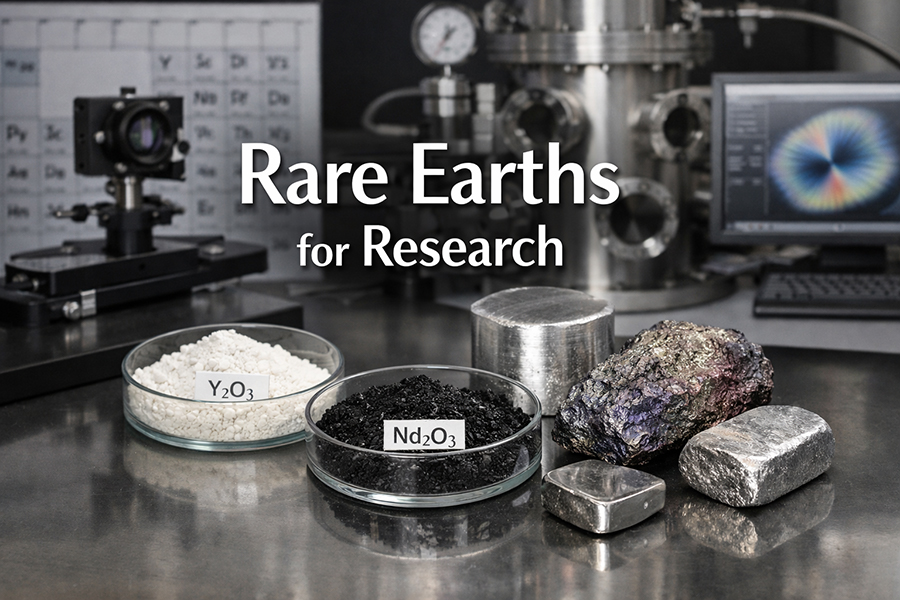








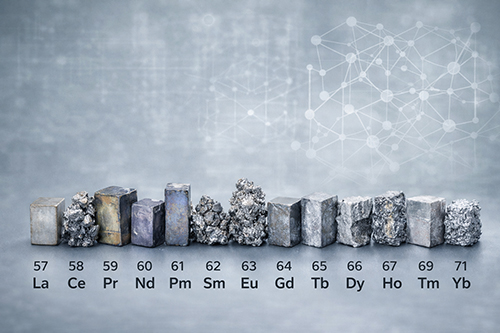
Rare earth metals are essential additives in alloys like magnesium and aluminum. They bring specific physical traits that matter in industrial applications. I've worked with these materials for years, and one thing I've learned is that small differences in atomic structure can make or break a material's performance. This article keeps things simple—just the key properties, backed by real numbers, and a few lessons from the shop floor.
When you add rare earth metals to an alloy, density is usually the first thing to look at.
Density comes down to three things: atomic mass, atomic radius, and how atoms pack together in the crystal lattice. Most rare earth elements have a close-packed hexagonal structure. Europium is the odd one out—its atomic radius is larger, so its density ends up lower than you'd expect.
Here are a few real numbers. Scandium comes in at about 2.989 g/cm³. That's about 70% denser than magnesium (1.741 g/cm³) and about 10% denser than aluminum (2.7 g/cm³). Yttrium runs around 4.46 g/cm³.
From Lanthanum to Lutetium, density climbs by nearly 60%. Heavier elements pack atoms tighter. Though atomic radius variations sometimes nudge the trend off course.
Melting point is another big one. It tells you how a material will behave when things get hot.
In the lanthanide series, melting points generally increase with atomic number. Cerium is on the lower end. Erbium melts around 1529°C. Yttrium is close at 1522°C. Scandium hits about 1541°C.
But not everything follows the script. Europium and Ytterbium have lower melting points than their neighbors. Their atomic radii are larger, which loosens things up.
Heat of fusion—the energy needed to melt the metal—tends to follow atomic number too. But again, there are exceptions. Samarium doesn't play by the rules; its elastic modulus is lower than Promethium and Neodymium. Europium's heat of fusion lands somewhere between Promethium and Gadolinium.
What's going on? It all comes down to bonding forces in the crystal lattice. How strongly atoms stick together determines both how hard it is to melt the metal and how stiff it ends up being.
Elastic modulus is just a fancy way of saying stiffness. For rare earth metals, stiffness depends on how well atoms bond.
In many cases, elastic modulus and heat of fusion follow the same trends as density and melting point. But a few elements break the pattern. That's a reminder that atomic bonds can vary quite a bit, even among elements that look similar on the periodic table.
One thing that stays consistent is specific heat. It's roughly the same across all rare earth metals. That means each one takes about the same amount of energy to raise its temperature by one degree. In my experience, that kind of predictability is useful when you're designing alloys for thermal applications.
Rare earth metals have an unusual electronic configuration. The electrons in the 4f orbital aren't tightly bound. That loose arrangement gives rise to magnetic and optical behaviors you don't see in most other elements.
Most rare earth metals show strong paramagnetic susceptibility. In plain English, they respond clearly to magnetic fields. They also have high magnetic saturation and significant magnetostriction—meaning they change shape slightly when you apply a magnetic field.
These traits make them useful for permanent magnets and magnetostrictive devices. Their magneto-optical properties—like rotating polarized light in a magnetic field—also show up in specialized equipment. Think magnetic refrigerators and optical isolators.
On the electrical side, the 4f electrons can affect conductivity and resistance. If you're designing alloys, it helps to have a basic sense of these magnetic and electrical traits. They affect how you balance weight, strength, and functionality in a component.
So how do these properties play out in real life?
| Alloy Base | Rare Earth Addition | What You Get |
|---|---|---|
| Aluminum | Scandium, Erbium | Better strength, thermal stability |
| Magnesium | Yttrium, Neodymium | Lightness + strength balance |
| Permanent magnets | Neodymium, Samarium | High magnetic performance |
When you add rare earth metals to aluminum, you get better strength and thermal stability. That's a big deal in automotive and aerospace applications. Add them to magnesium, and you get a nice balance between lightness and strength—light enough for fuel efficiency, strong enough to hold up under stress.
The magnetic properties also come into play. A small but reliable magnet can make or break an electronic component. A lot of everyday machines—the ones that just work, no questions asked—rely on parts made with rare earth alloys.
The specifics change depending on the application. But the common thread is control. Fine-tune the elemental properties, and you can tailor the material to perform exactly how you need it to.
Choosing a rare earth metal for an alloy isn't a theoretical exercise. Cost matters. Processability matters. Long-term stability matters.
One thing that helps is the uniform specific heat we mentioned earlier. It makes thermal behavior predictable, which is useful in high-temperature applications.
But you still have to watch the details. Small differences in bonding strength can shift how the final product behaves. When you're making components that need to run reliably for years, understanding those little differences makes all the difference.
Rare earth metals bring a useful mix of physical properties to alloy design. Density, melting point, stiffness, magnetic behavior—all of it comes down to atomic mass, bonding, and electron configuration.
Having solid data helps. Scandium's density at 2.989 g/cm³. Yttrium's melting point around 1522°C. Numbers like that give you a place to start when you're making technical decisions.
Keep it practical. Focus on the details that actually affect performance. That's how you end up with materials that work the way you need them to, across a wide range of conditions.
When you're ready to put these materials to work, Stanford Materials Corporation (SMC) has the rare earth metals you need—reliable, consistent, and backed by real-world experience.
Eric Loewen
Eric Loewen graduated from the University of Illinois studying applied chemistry. His educational background gives him a broad base from which to approach many topics. He has been working with topics about advanced materials for over 5 years at Stanford Materials Corporation (SMC). His main purpose in writing these articles is to provide a free, yet quality resource for readers. He welcomes feedback on typos, errors, or differences in opinion that readers come across.

 Inquiry List