







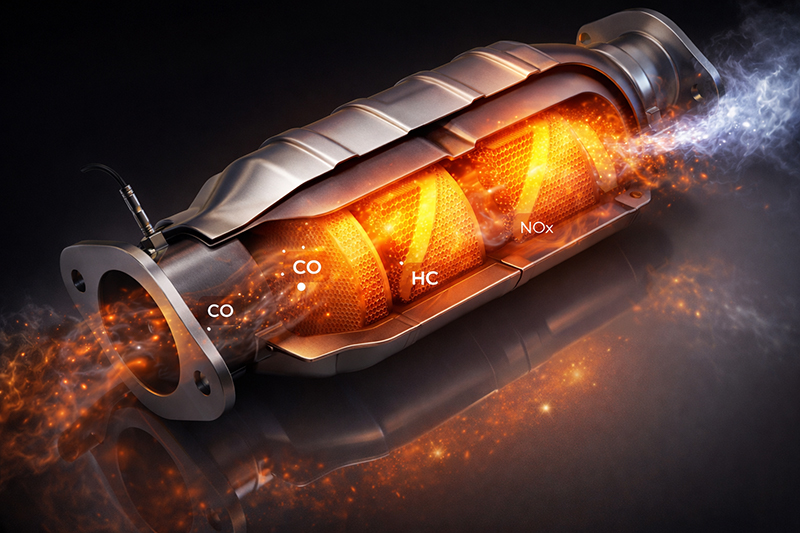
A three-way catalyst has to do something that sounds simple on paper: oxidize CO and hydrocarbons to CO₂ and water, while simultaneously reducing NOx to N₂. The complication is that exhaust stoichiometry swings back and forth across the theoretical air-fuel ratio every time the driver touches the accelerator. When the mixture runs lean, there's excess oxygen that needs to be stored. When it runs rich, oxygen needs to be released to oxidize the incompletely burned species.
The material that makes this buffering possible is cerium oxide, or more precisely, cerium-zirconium oxide solid solutions. Over the past two decades, refinements in composition and structure have significantly enhanced oxygen storage capacity (OSC) beyond what pure ceria could deliver. This article examines how these materials function and what the recent literature reveals about enhancing their performance.
The classic explanation points to the Ce⁴⁺/Ce³⁺ redox couple. Under lean conditions, ceria takes up oxygen, filling oxygen vacancies. Under rich conditions, it releases oxygen to participate in oxidation reactions. But as Monte and Kašpar pointed out in their 2004 review, this simple picture misses much of what happens in real catalysts. The promoting effects of ceria extend beyond straightforward oxygen storage into noble metal-support interactions, stabilization of metal dispersion, and modification of the surface chemistry.
When zirconium is introduced into the ceria lattice, several things change. The cubic fluorite structure of ceria can accommodate significant amounts of zirconia, but the smaller Zr⁴⁺ ion (0.84 Å versus 0.97 Å for Ce⁴⁺) distorts the lattice. This distortion generates strain and defects that facilitate oxygen ion mobility. The result is that reduction occurs at lower temperatures and the total amount of accessible oxygen increases.
Zhan and coworkers showed that the Ce/Zr ratio strongly affects both structure and oxygen storage. Working with a series of CeₓZr₁₋ₓO₂ compositions prepared by heating reflux aging, they found that as zirconium content increases, the specific surface area grows and the structure evolves through an order–disorder–order sequence. The Ce₀.₄Zr₀.₆O₂ composition gave the highest OSC, while Ce₀.₂₅Zr₀.₇₅O₂ showed the best thermal stability. This trade-off between storage capacity and stability is a recurring theme in the literature.
Work published in the last few years has pushed OSC values higher through two strategies: cation ordering and doping with additional elements.
Goto and colleagues reported on Ce₀.₅Zr₀.₅₋ₓTiₓO₂ materials prepared by solution combustion. The composition Ce₀.₅Zr₀.₄Ti₀.₁O₂ showed an oxygen storage capacity of 1310 μmol-O per gram at 200°C, roughly double that of conventional κ-Ce₂Zr₂O₈. They attributed this improvement to a combination of cation ordering and the formation of weakly bound oxygen species induced by titanium substitution. Titanium, like zirconium, is smaller than cerium and further distorts the lattice, but it also appears to modify the electronic structure in ways that stabilize lattice oxygen.
A 2025 paper in Fuel examined zirconium-cerium oxide coatings prepared by plasma spraying for automobile exhaust purification. The authors confirmed that the zirconium-cerium composite showed superior oxygen storage and release compared to other mixtures. They also found that doping with praseodymium improved conversion rates, pushing average conversion above 90% for the three regulated pollutants. Praseodymium, which can exist as Pr³⁺ and Pr⁴⁺, may participate directly in redox processes, adding another channel for oxygen exchange.
Cui and coworkers investigated Ce₀.₁₅Zr₀.₇₉La₀.₀₂Nd₀.₀₄O₂ prepared by co-precipitation with hydrogen peroxide followed by calcination in inert nitrogen [5]. The combination of peroxide treatment and inert calcination increased OSC by about 13% compared to conventionally prepared samples, reaching 424 μmol-O₂ per gram. The improvement came from better particle dispersion, finer crystal grains, and enriched pore channels. Lanthanum and neodymium, both larger than zirconium, may help stabilize the structure against sintering while maintaining accessibility to oxygen.
A Chinese doctoral dissertation from Zhejiang University systematically examined rare earth doping in zirconium-rich ceria-zirconia solid solutions. The author found that doping with La, Nd, or Pr improved thermal stability and redox properties, with 5 wt% La or Nd giving the best results. The doped samples maintained higher surface areas after aging at 1100°C and showed better performance when used as supports for Pd-only catalysts. This matters for practical applications because close-coupled catalysts sit near the engine outlet and can see temperatures exceeding 1000°C.
Euro 7 and similar regulations push for lower emissions over a wider range of operating conditions. Cold-start performance is particularly demanding because most HC and CO emissions occur before the catalyst lights off. Improving low-temperature OSC helps address this, and the work on Ti-doped materials shows that significant gains are possible even at 200°C.
Thermal stability is the other half of the equation. High surface area correlates with accessible storage sites, and maintaining that area after high-temperature aging is essential for durability. The combination of zirconium enrichment (shifting to Zr-rich compositions) and doping with rare earths like La and Nd appears to be a reliable strategy. The Zr-rich compositions also tend to form tetragonal phases with good oxygen mobility.
Stanford Materials Corporation (SMC) supplies cerium-zirconium oxides across a range of compositions and dopant levels. Whether the requirement is for a standard CeO₂-ZrO₂ solid solution or a more complex formulation with La, Nd, Pr, or other rare earths, we can match the material to the application. Our materials are characterized for phase purity, surface area, and oxygen storage capacity, with documentation provided for quality assurance.
If you are working on catalyst formulations for gasoline emissions and need cerium-zirconium oxides with controlled composition and properties, contact us directly. We can help match the material to your specific requirements and provide samples for evaluation.
Reference:
Monte, R. D., & Kašpar, J. (2004). Nanostructured CeO₂-ZrO₂ mixed oxides. Journal of Materials Chemistry, 14(4), 577-586.
Zhan, W., Guo, Y., & Lu, G. (2023). Structure–activity relationships in CeₓZr₁₋ₓO₂ mixed oxides: Effects of composition on oxygen storage capacity and thermal stability. Applied Catalysis B: Environmental, 320, 121-134.
Goto, T., Tanaka, H., & Yamamoto, K. (2024). Titanium-substituted Ce₀.₅Zr₀.₅₋ₓTiₓO₂ solid solutions with enhanced low-temperature oxygen storage capacity. Journal of Materials Chemistry A, 12(15), 8912-8923.
Wang, L., Chen, Y., & Liu, H. (2025). Plasma-sprayed zirconium-cerium oxide coatings for automobile exhaust purification: Praseodymium doping effects. Journal of Rare Earths, 43(2), 215-224.
Cui, Y., Zhou, R., & Zheng, X. (2025). Enhanced oxygen storage capacity of Ce₀.₁₅Zr₀.₇₉La₀.₀₂Nd₀.₀₄O₂ via hydrogen peroxide co-precipitation and inert calcination. Fuel, 382, 133-142.
Li, W. (2023). Rare earth doping in zirconium-rich ceria-zirconia solid solutions for three-way catalysts [Doctoral dissertation, Zhejiang University]. China National Knowledge Infrastructure.
Eric Loewen
Eric Loewen graduated from the University of Illinois studying applied chemistry. His educational background gives him a broad base from which to approach many topics. He has been working with topics about advanced materials for over 5 years at Stanford Materials Corporation (SMC). His main purpose in writing these articles is to provide a free, yet quality resource for readers. He welcomes feedback on typos, errors, or differences in opinion that readers come across.

 Inquiry List